
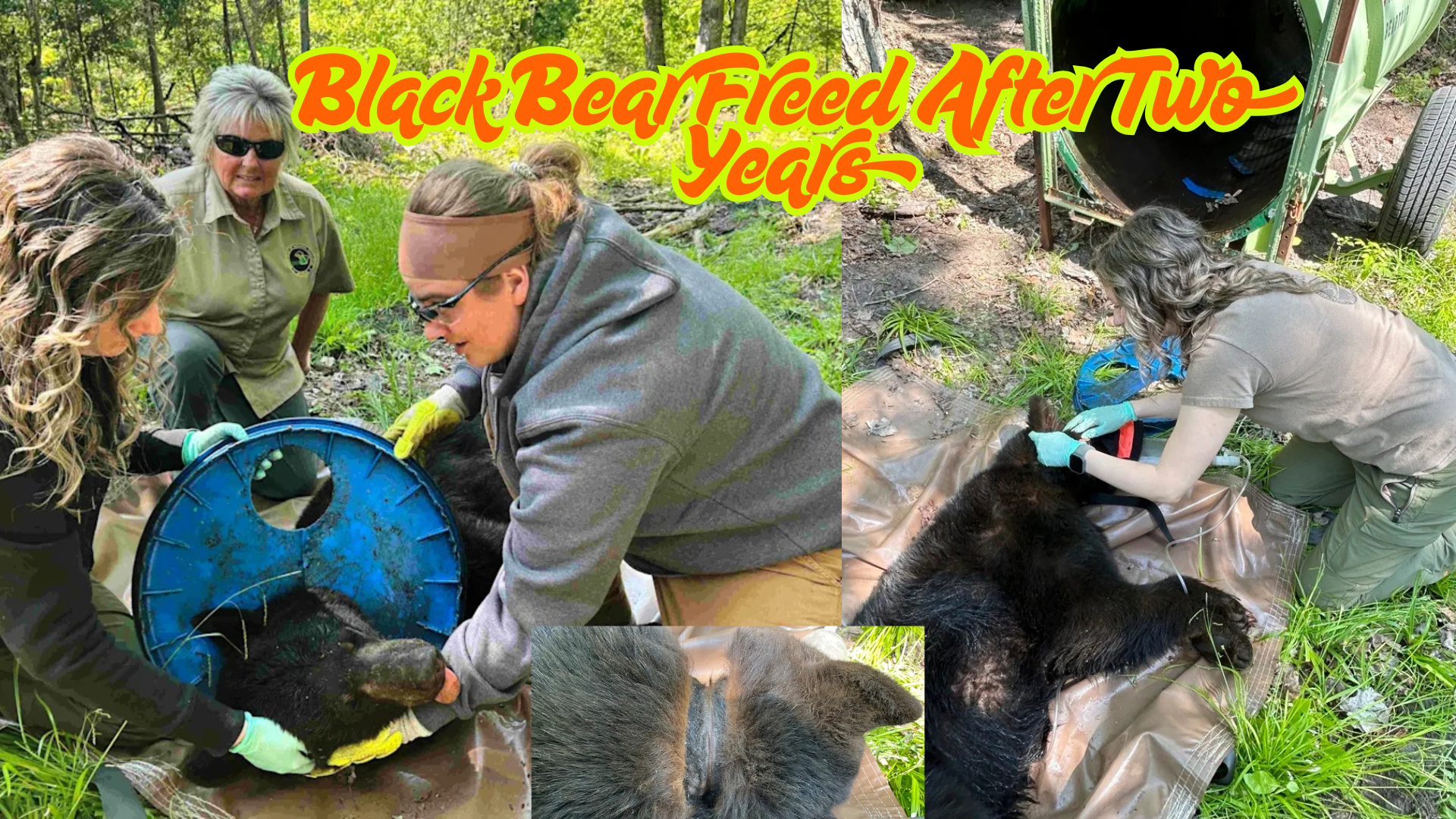
For two long years, a black bear in Michigan roamed the forests of the northern Lower Peninsula with an unusual and distressing burden — a large, hard plastic lid trapped tightly around its neck. The makeshift collar had embedded into the bear’s skin, leaving deep scars and patches of missing fur. But against all odds, the bear managed to survive — and now, thanks to the persistence and skill of Michigan wildlife experts, it is finally free.
On June 3, a team from the Michigan Department of Natural Resources (DNR) successfully trapped the bear, removed the plastic lid, and released the animal back into the wild, marking the end of an unusual and painful chapter for the resilient young creature.
A Startling Sight on Trail Cameras
The saga of the bear began in 2023, when it was first spotted as a cub on a trail camera. Even then, the plastic barrel lid was already encircling its neck. Wildlife officials were immediately concerned but knew that tracking down and capturing a free-roaming wild bear — especially in the dense woodlands of northern Michigan — would be no easy task.
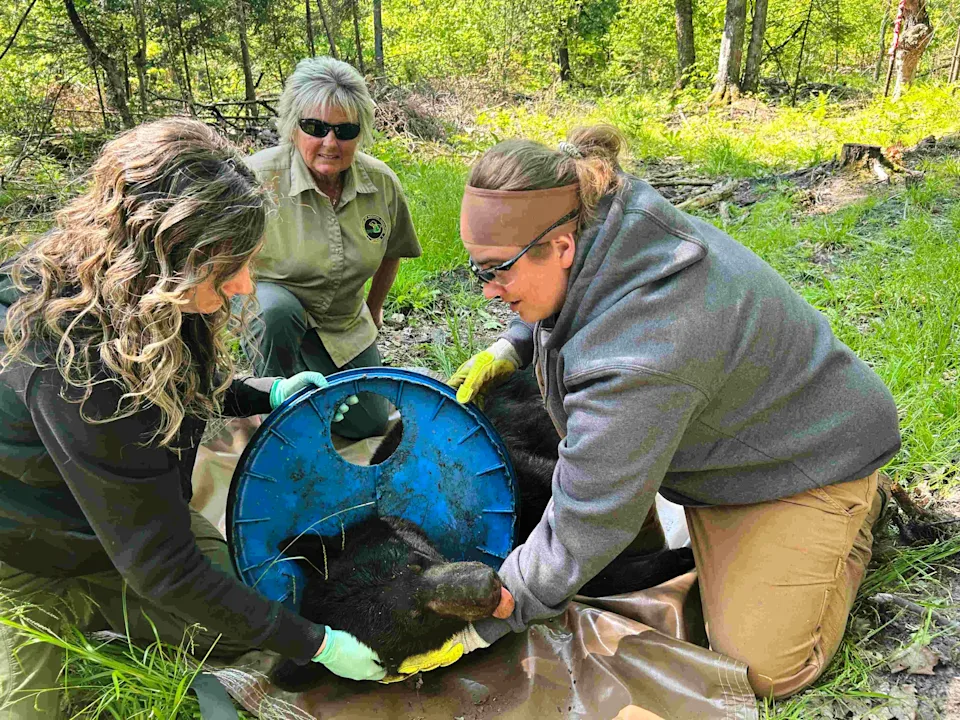
In this image provided by the Michigan Department of Natural Resources, wildlife biologist Angela Kujawa collects data from an immobilized black bear after a lid was removed from the animal’s neck near Hillman, Michigan, on June 3, 2025. ( Michigan Department of Natural Resources via AP)ASSOCIATED PRESS
Less
“From the very first photo, we knew this was going to be a difficult case,” said Cody Norton, a large carnivore specialist with the DNR. “Trying to locate and safely trap a wild bear is always a challenge, and this one had been particularly elusive.”
Throughout the next two years, the bear occasionally reappeared on cameras set up by hunters, hikers, and researchers — each time with the same hard plastic lid still stubbornly stuck around its neck. Despite this, it appeared to be alive, mobile, and even growing in size.
A Surprising Capture
In late May 2025, nearly two years after the first sighting, the bear was spotted again on a trail camera. This time, the DNR was ready. Officials quickly set up a cylindrical bear trap in the area where the bear had been seen. The trap was baited, and within a few days, the bear wandered in. The door shut behind him.
“It was a huge relief,” Norton said. “After years of trying to track him down, we finally had him in a safe, controlled environment.”
The team immediately got to work. Wildlife biologists sedated the bear using an injection, then carefully examined the plastic lid. It had been cutting into the bear’s neck, but thankfully, no bones or major blood vessels were damaged.
“We were able to cut the lid off within a few minutes,” said Angela Kujawa, a wildlife biologist who assisted in the rescue. “It was tough plastic, but not impossible to cut through once the bear was sedated. Our main concern was ensuring the procedure didn’t add to his stress.”
A Bear’s Resilience
Despite the trauma of carrying the lid for so long, the bear was found to be in relatively good health. He weighed about 110 pounds — typical for a 2-year-old black bear — and aside from the visible scarring around his neck, there were no signs of infection or serious malnourishment.
“We were honestly shocked at how well he’d been doing,” Norton said. “It’s pretty incredible that the bear survived and was able to feed itself. He probably adapted to living with the obstruction better than we ever imagined.”
Kujawa noted that the lid likely impacted the bear’s behavior and comfort. “It probably restricted his head movement a bit and may have made climbing trees harder,” she said. “He likely spent more time lying on his back or side instead of his stomach to avoid pressure on the lid.”
Once the lid was removed and the bear was fully awake, he was released back into the forest. Biologists watched as he slowly regained his footing and ambled away into the trees — lid-free for the first time in two years.
How Did This Happen?
It remains unclear exactly how the plastic lid ended up around the bear’s neck in the first place. Wildlife officials suspect it may have come from a bait barrel used during hunting season. In Michigan, bear baiting is legal, and hunters often use barrels with lids containing small openings to dispense food. Regulations require the openings to be large enough to prevent animals from becoming trapped — but in this case, the opening may have been too narrow, or the lid may have been discarded carelessly.
“It’s a stark reminder of how our actions can have unintended consequences,” Norton said. “Even something as simple as leaving behind a plastic lid can have a major impact on wildlife.”
He urged hunters, outdoor enthusiasts, and the general public to be more mindful of the materials they leave in nature. “Bears are curious, resourceful animals. They’ll explore anything that smells like food. This bear got incredibly lucky. The next one might not.”
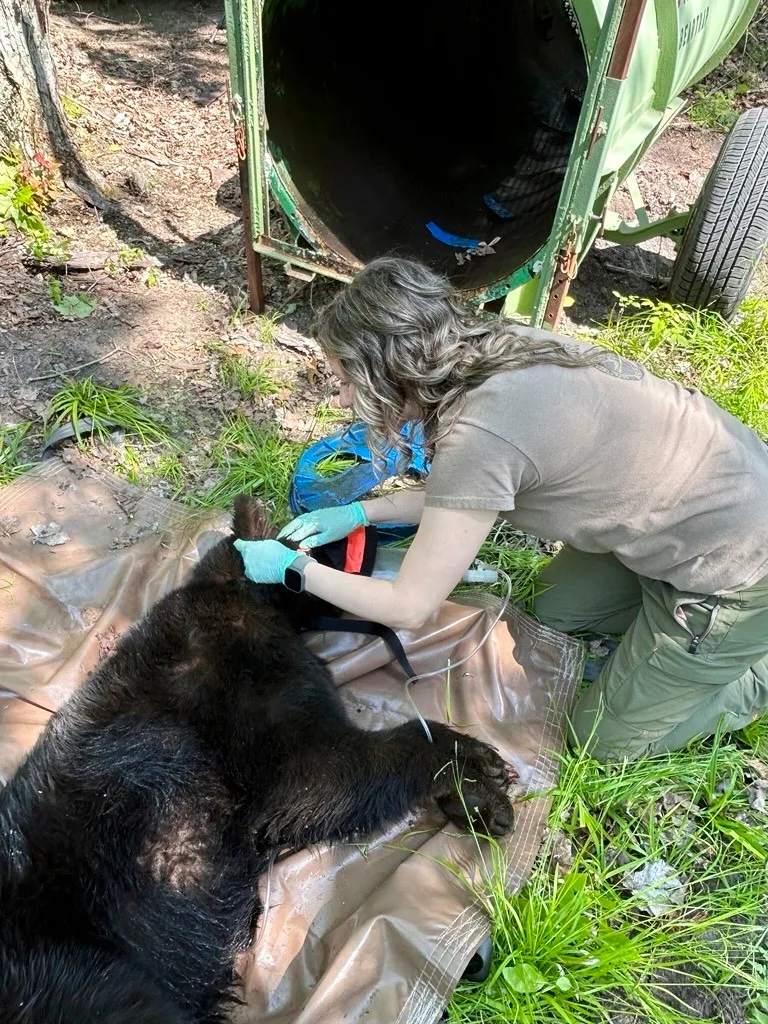
In this image provided by the Michigan Department of Natural Resources, wildlife biologist Angela Kujawa collects data from an immobilized black bear after a lid was removed from the animal’s neck near Hillman, Michigan, on June 3, 2025. ( Michigan Department of Natural Resources via AP)ASSOCIATED PRESS
Less
A Message of Hope — And Caution
The successful rescue of the bear has been celebrated by conservationists and animal lovers alike. It serves as a powerful example of animal resilience and the importance of human intervention in mitigating harm — especially when human activity is the cause.
“It’s always rewarding when we can directly help an animal in distress,” Kujawa said. “This bear’s survival — and now his freedom — is a testament to the strength of wildlife and the importance of our work.”
But the story also serves as a warning. The DNR is now reviewing its education and outreach efforts regarding baiting practices, hoping to prevent similar incidents in the future. Officials say they will continue to work with hunting communities to reinforce best practices and to monitor for other cases of entangled or injured wildlife.
As for the bear, he now has a second chance at life — unburdened and free to roam the woods of Michigan as nature intended.
“We’ll keep an eye out for him in the future,” Norton said. “But next time we see him on a trail cam, we hope it’s just a normal bear doing bear things — no lid, no scars, just wild and free.”