
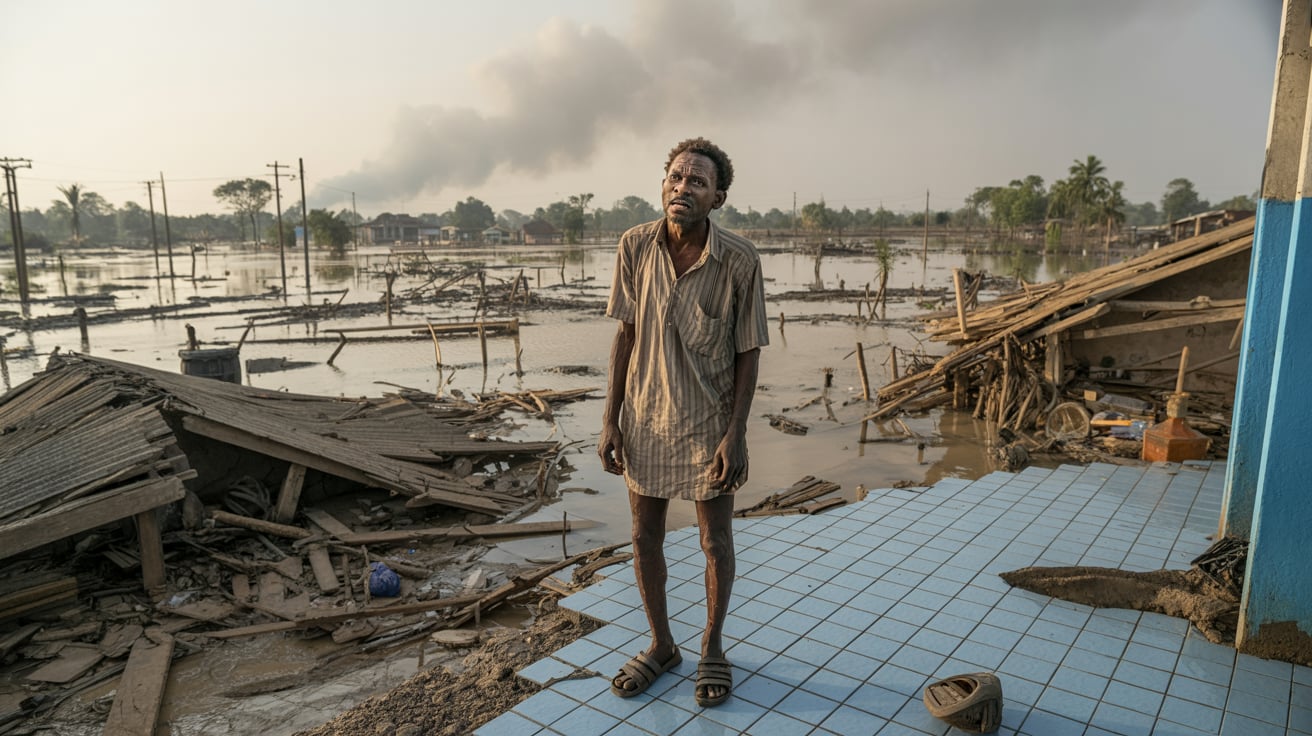
Adamu Yusuf’s world was shattered when devastating floods tore through his town in north-central Nigeria, claiming the lives of nine members of his family.
The 36-year-old father said his wife and newborn baby were among those swept away in the early hours of Thursday in Tiffin Maza—one of the two hardest-hit communities in Mokwa, Niger State.
“She was the one who woke me when the flood hit,” Yusuf recalled. “I quickly gathered the family and told everyone to hold onto each other. But when we stepped outside, water was already flooding our living room and the entire compound. Panic set in, and we became separated.”
His wife and baby had just returned to Mokwa the day before, after staying with her parents for several weeks following the birth.
“I watched helplessly as the water washed away my family,” he said quietly. “I only survived because I knew how to swim. It was God who saved me.”

Local officials say the death toll has surged to over 200 as of Sunday, a sharp increase from 110 reported on Friday. More than 500 people remain missing, and authorities have called off rescue operations, saying they believe there is little hope of finding more survivors, a local official told Global Now.
Grief and devastation hung heavily over the community of Tiffin Maza on Saturday, as residents came to terms with the scale of destruction left by the floods.
The remnants of life before the disaster lay scattered—soaked mattresses, torn clothing, and twisted sheets of metal roofing marking the sites of homes now reduced to rubble. The few buildings still standing bore visible scars: collapsed walls, gaping holes, and roofs torn clean off by the force of the water.
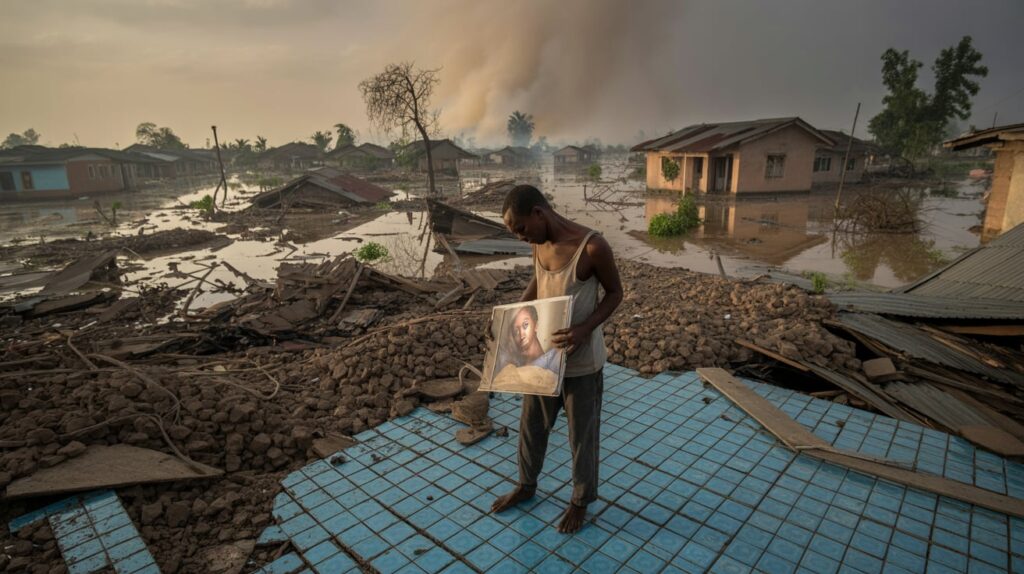
Adamu Yusuf stood silently on the blue-tiled floor where his bedroom once stood—now one of the only traces left of his home and community.
“I lost everything in this flood,” he said, staring out at the desolate landscape. “But the most painful loss is that of my family. The only thing I own now is the cloth I’m wearing—and even that was given to me by a friend.”
He said the body of one relative has been recovered, but he has “resigned to fate” that the rest of his family will not return alive.
For others, the heartbreak has been equally profound.
Nineteen-year-old Isa Muhammed, a recent high school graduate, has been inconsolable since learning that his beloved teacher’s house was swept away with nine family members inside.
“Two bodies have been found—one was his baby,” Isa said. “My teacher, his second child, his sister, and four other relatives are still missing. His wife wasn’t inside at the time, but a building collapsed on her and she died instantly.”
Isa also lost someone dear to him—his uncle Musa, who stepped in as a father figure after his own father died in 2023.
“Uncle Musa was everything to me. He raised me, taught me to value education, and always told me to do the right thing,” he said, tears welling up. “Whenever I’m alone and think about him, I just cry. I haven’t been able to sleep since the flood.”
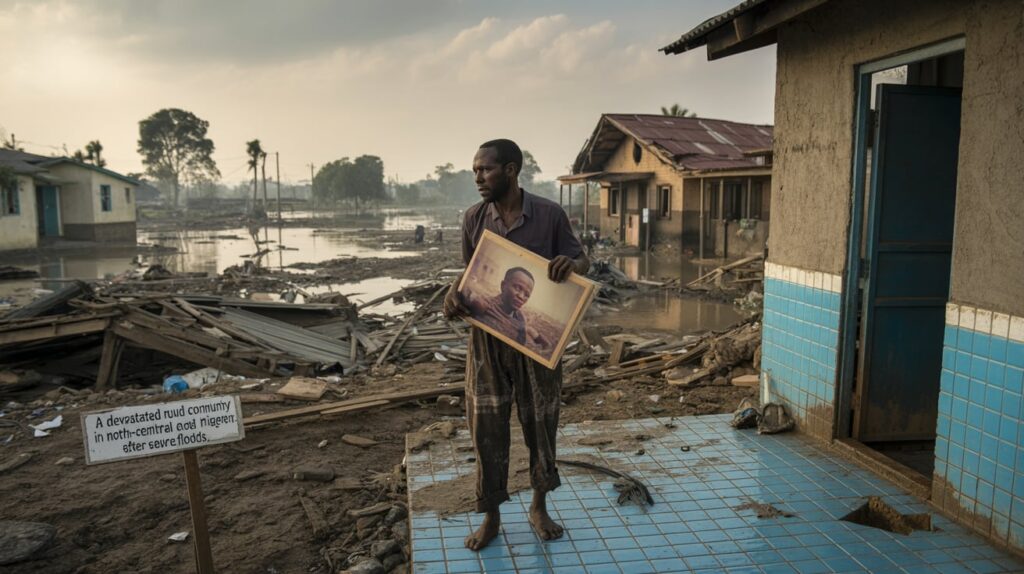
Although the water has now receded, the aftermath is grim. On Saturday, residents gathered to console one another and assist in the ongoing search for the missing.
Locals told BBC News that in some areas, the floodwaters rose as high as seven feet (2.1 meters), engulfing homes and leaving behind thick layers of mud and debris. A pungent odor now lingers over parts of the community—residents fear it signals more bodies still buried beneath the silt.
They are determined to recover their loved ones and give them proper burials, as they have done for others since Thursday.
“I’ve never seen floods like this in my life,” said 65-year-old Ramat Sulaiman. “But I’m grateful that my family survived.” Her house, however, was completely destroyed, leaving her and her relatives without shelter.
She said that 100 children who used to sleep at a Quranic school just two blocks from her home were all swept away by the floods.
“It was heartbreaking to witness,” she said. “The children cried out for help, but no one could reach them. As their cries grew louder, the building slowly sank and was carried away by the floodwaters.
Her son, Saliu, has been left homeless and financially devastated.
“I lost at least $1,500 in the flood—money I had earned from selling farm produce just the day before,” he explained. “I thought about going back to retrieve it, but the force of the water was too frightening.
He also lost eleven bags of groundnuts and seven bags of beans. “My wife and I couldn’t salvage anything from our home. But I’m grateful we escaped in time. The floodwaters were filled with so many bodies.
Since the disaster, Saliu has been plagued by nightmares.
I’m deeply traumatized He said.
Authorities have yet to confirm whether a dam failure contributed to the devastating floods in north-central Nigeria, as many residents have speculated.
The District Head of Mokwa, Alhaji Muhammadu Shaba Aliyu, told the BBC that a reservoir exists in the area and is capable of overflowing “anytime there’s rain.” However, he acknowledged that the scale of the recent flooding was far beyond anything previously experienced.

Many locals are skeptical that rainfall alone caused the destruction.
“This flood wasn’t caused by rain,” said Mr. Muhammed, a resident of the affected area. “It had already stopped raining, and there was no water anywhere. I was outside when, suddenly, water came rushing down at high speed, sweeping everything in its path.”
Another resident, Ms. Ramat Sulaiman, described a similarly bewildering experience.
“When I got up for prayers and opened the door, there was no sign of water,” she said. “Moments later, I heard people screaming. The flood came out of nowhere. We still don’t know its source—it’s a mystery.”
Mr. Adamu, who lost nine members of his family, echoed that disbelief.
“Anyone saying rain caused this flood is lying,” he said. “The rain had already stopped. Nobody knows where this flood came from—only God.”
Local officials seem to agree. Musa Alhaji Aliyu Kimboku, the Deputy Chairman of the Mokwa Local Government, also dismissed the idea that rainfall alone caused the disaster.
Meanwhile, the National Emergency Management Agency (NEMA) reported that those injured in the disaster are receiving treatment, while displaced residents have been relocated to temporary resettlement camps. Relief materials are being distributed to help affected families.
According to the Nigerian Meteorological Agency, the central region of the country is expected to see up to 200 days of rainfall this year, with even longer rainy seasons projected for southern states. Earlier in May, the federal government launched a flood awareness campaign to educate the public about flood risks.
Thirty of Nigeria’s 36 states are considered at high risk for flooding—including Niger State, where this disaster occurred.
As survivors attempt to salvage what remains of their lives and belongings, the emotional toll remains overwhelming. For those like Mr. Adamu, who lost nearly everything, recovery feels impossible.
I’ve accepted my fate,” he said. But the pain—especially the loss of my family—that will never heal.


2 thoughts on “I stood helpless as the floodwaters swept my family away in Nigeria”