
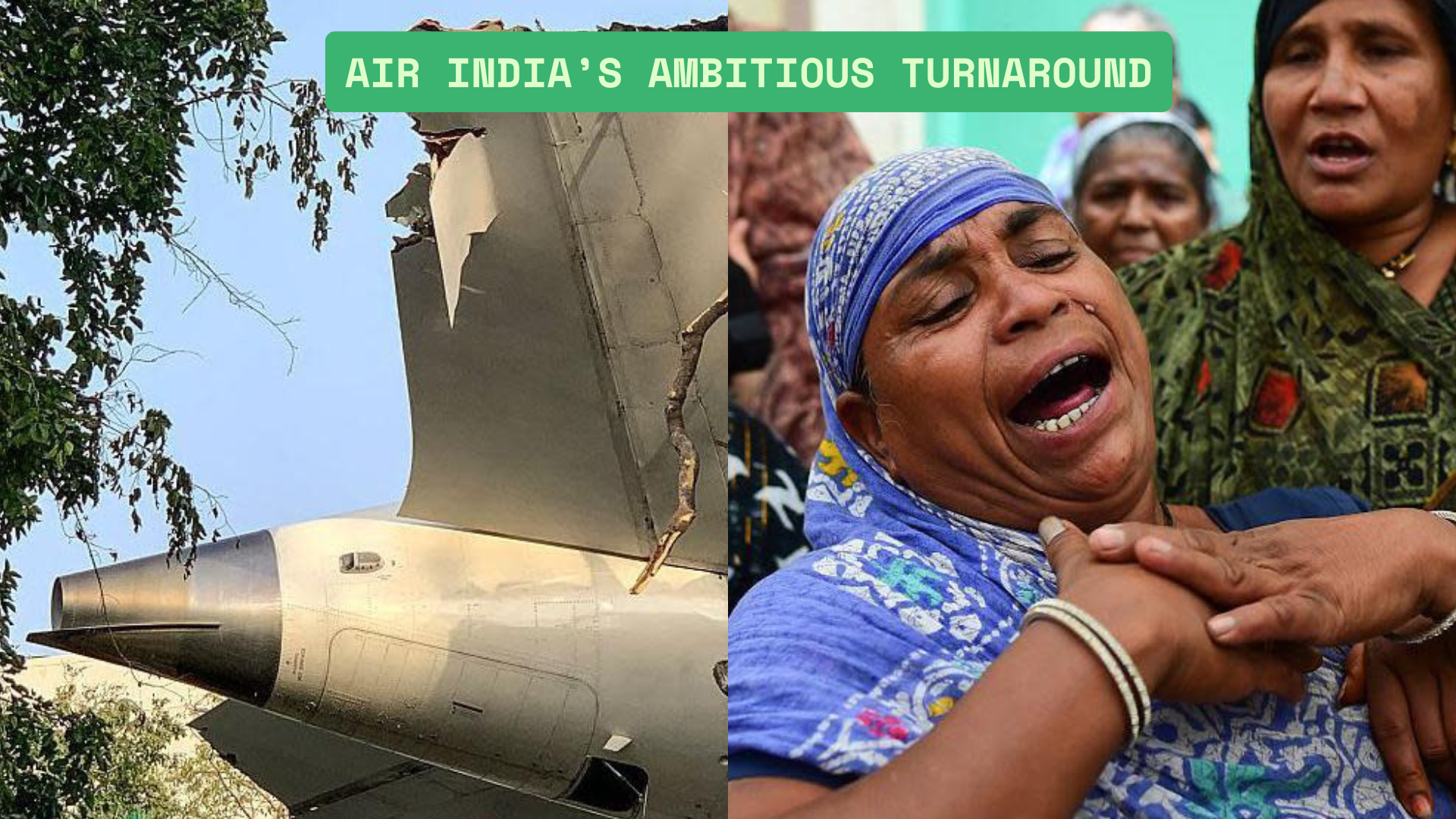
Just days after the catastrophic crash of Air India Flight 171 claimed the lives of at least 270 people, a multinational team of investigators is racing to determine what led to the tragedy. As the world watches and waits for answers that may take months to surface, the disaster has cast a long shadow over Air India’s carefully charted revival journey — one that the Tata Group hoped would turn the ailing airline into a world-class carrier.
This crash comes at a crucial moment in Air India’s transformation story. Since the Tata Group reacquired the airline from the Indian government in 2022, a series of sweeping reforms had sparked cautious optimism. Operational profits, improved revenues, and a noticeable decline in customer complaints marked the early signs of progress. Despite ongoing concerns about inflight entertainment issues, service inconsistencies, and lingering delays, industry watchers were willing to attribute these to growing pains during a complex transition phase.
Air India had been aggressively modernizing. The airline revealed a sleek new livery, refurbished cabin interiors, and the induction of brand-new Airbus A350s on major routes. It also placed a record-breaking order for hundreds of new aircraft, a signal of intent that it was ready to compete in India’s rapidly growing aviation market. The Tata Group described the airline’s recovery as being in the “final climb phase,” suggesting that the most turbulent part of the journey was behind them.
Then came the crash.
In the aftermath, fear and uncertainty have gripped the public. “I’ll never fly Air India again” became a common sentiment among distraught passengers and anxious travelers. While the Boeing 787 Dreamliner, the model involved in the crash, has a strong global safety record, aviation experts note that such visceral reactions are inevitable after a high-casualty disaster. Unfortunately, this sudden erosion of passenger confidence threatens to derail the turnaround efforts just as they were beginning to gain momentum.
The situation is being compounded by a string of unrelated incidents. Earlier this month, technical snags on engines and a hoax bomb threat on a Phuket-to-Delhi flight added to public unease. “There will definitely be a short-term impact where people may be wary of flying Air India,” said Jitendra Bhargava, former executive director of the airline. “The disaster was very tragic… and the event will stay in people’s memories for long.”
Airline analyst Shukor Yusof, founder of Singapore-based Endau Analytics, echoed that sentiment. “Bookings are already being canceled. The airline was already a tough turnaround case due to legacy financial and operational baggage. This will now take more time than anyone expected,” he warned. He also noted that the Tata Group will be forced to divert resources away from operational improvements to deal with legal, insurance, and reputational challenges — all of which could span years.
Drawing comparisons to Malaysia Airlines’ twin tragedies in 2014 — from which it took a decade to recover financially — Yusof said Air India will similarly need time to “heal.” In the interim, India’s aviation boom may benefit rival airlines poised to pick up the slack.
The crash has already begun to disrupt operations. Air India has announced a 15% reduction in international services using its wide-body aircraft through mid-July. The move comes as part of a broader push for heightened safety inspections and amid growing airspace restrictions. This operational pullback, though necessary, could further strain customer loyalty and revenue targets.
Meanwhile, the ongoing investigation into the crash promises to keep the airline under intense international scrutiny. Aviation authorities from the UK, US, and India are all involved, examining everything from maintenance protocols to the condition of Air India’s older aircraft. “There will be tough questions about what the airline has done to upgrade its aging fleet and whether it has met global safety standards,” said aviation analyst Mark Martin.
For Air India, the next phase will hinge not only on safety overhauls but also on public perception. Mitu Samar Jha, who leads a corporate risk and reputation advisory firm in Mumbai, emphasized the importance of consistent and transparent communication. “Too often, companies focus on the initial crisis response but fail to keep the world updated on progress. That vacuum allows misinformation to flourish and erodes trust further,” she said.
She believes the Tatas now face a “triple whammy”: They must answer for the legacy fleet they inherited, confront Boeing’s manufacturing troubles, and account for their own maintenance practices. It’s a steep hill to climb — one that requires authenticity, empathy, and action in equal measure.
Despite the bleakness, Air India is not without strengths. CEO Campbell Wilson has pledged full cooperation with investigators and committed to supporting victims’ families. In a town hall shortly after the crash, Tata Group Chairman N. Chandrasekaran described the accident as the “most heartbreaking” moment of his career and urged employees to remain resilient, framing the disaster as an opportunity to rebuild the airline with an even greater focus on safety.
Industry insiders point out that the airline is home to some of the world’s most experienced pilots and engineers. Aviation consultant Sanjay Lazar says enhanced safety protocols following the crash could eventually reassure passengers. “History shows that after such incidents, airlines become hyper-vigilant — much like a homeowner reinforcing locks after a burglary. Every SOP will be followed to the letter,” he noted.
Tata’s alliance with Singapore Airlines — a global benchmark for excellence in aviation — also provides a potential stabilizing force. Analysts believe SIA could play a crucial role in mentoring Air India back to health, leveraging its safety culture and customer service expertise.
For now, however, the challenge before Air India is immense. It must manage operational setbacks, regain passenger trust, respond transparently to investigations, and deliver on its ambitious transformation goals — all at the same time.
The airline’s path forward will not be easy, but if it can navigate this crisis with courage, clarity, and care, there may still be hope for a successful turnaround. In the aviation industry, resilience often defines legacy — and Air India is at a defining crossroads.
3 thoughts on “Devastating Crash Threatens Air India’s Ambitious Turnaround”